Skip to content
AI NEWS JOURNAL
FOLLOW THE THREAD

千问 Qwen

Follow the latest facts and developments on one topic.

Newest first

Corrupting Ties: Investigating Robustness to Bias Injection Across Multi-Agent Network Topologies

arXiv:2611.21804v1 Announce Type: new Abstract: AI systems are increasingly deployed in high-stakes decision-making contexts, where interactions among components can introduce fairness risks that remain undetected when auditing components or collective outcomes in isolation. As LLM-based multi-agent systems become more prevalent, understanding how biased information propagates through agent interactions is essential for assessing their fairness. We introduce a controlled bias injection framework that replaces selected agent responses with predefined biased ones, enabling an intervention-based analysis of how network topology and injection configurations shape system behavior. We propose decision divergence metrics that quantify the effects of these interventions at the agent, network, and system levels, and evaluate five topologies on three binary classification tasks using LLMs from the Qwen and Gemma families. Sequential networks show the greatest divergence, whereas fully connected and mesh networks show less. Injection position also matters: in star networks, injecting the central agent has larger effects than injecting peripheral agents. Models further differ in whether divergence follows the injected bias. These findings highlight the role of network structure in the propagation of biased information and motivate topology-aware auditing of fairness risks in multi-agent systems.

Disambiguating Moral Circuits and Moral Features in Language Models: Moral content, normative judgment or cue words? Evidence from 14 models

arXiv:2611.21705v1 Announce Type: new Abstract: Interpretability methods can locate the attention heads and sparse autoencoder (SAE) features that change the answer a language model gives to a moral prompt, e.g., whether "Stealing medicine for a dying child is morally" continues with "justified" or "wrong". Such a component could respond to moral content, to the judgment of conduct by any norm, or to the word "morally" in the prompt. We built 227 minimal pairs of short phrases, validated by five annotators, whose two versions differ in a moral standard, in another kind of norm (prudence, etiquette, aesthetics or evidence) or in a descriptive quality, and showed them to 14 open-weight models (Llama, Gemma and Qwen, 1B to 14B, base and instruction-tuned), with and without the word "morally". In every model, the heads that change the moral answer belong to an evaluation circuit the models use for every kind of normative judgment we tested: these heads carry the same share of the effect for moral as for other normative pairs (pooled ratio 1.00, 97.5% confidence interval [0.92, 1.07], with the word; 0.90, [0.84, 0.96], without it), and the models need them as much for both. The models need these heads also when nothing in the prompt asks for a judgment, and on 400 scenarios of the ETHICS benchmark, where removing them takes away 37 to 39% of the difference between acceptable and unacceptable scenarios, against 1 to 3% for ten random heads. The SAE features we located respond mostly to the word "morally" rather than to what the phrase is about. The models represent the category of a pair (the standard the annotators assigned to it): it can be read from their hidden states, and, in the eight models we tested, removing the direction that carries it weakens the moral verdict by a few percent, and more than the other verdicts in seven of them. We release the pairs, the ratings, the code, the trained SAE dictionaries and the result files.

UMM-JEPA: Generative Pretraining via Masked Next-Scale Representation Prediction for Unified Multimodal Models

arXiv:2611.18668v1 Announce Type: new Abstract: Unified multimodal models can support both visual understanding and generation, yet generative training does not necessarily improve understanding. We argue that this limitation may arise from a mismatch between the representation targeted by generation and the perceptual representation used for understanding. Conventional generation objectives primarily optimize synthesis-oriented spaces such as discrete visual codes or generative latents. We therefore introduce UMM-JEPA, which reformulates generation as progressive prediction of continuous visual-understanding representations. The model constructs a multi-scale representation hierarchy from coarse to fine, while pixel rendering is decoupled from representation pretraining and attached only afterward. Controlled comparisons show that the representation-prediction objective accounts for most of the understanding improvement, while a data-matched control leaves the group means nearly unchanged. UMM-JEPA reaches a 16-benchmark visual mean of 51.71, against 46.36 for the understanding-only Qwen-VL baseline, and the text mean also rises. Compared with discrete-code and latent-flow generation objectives, perceptual representation prediction yields stronger and more consistent transfer to understanding. Linear probes and visual-evidence interventions further reveal richer object and spatial structure and stronger use of image-specific information. These results suggest that generation can benefit understanding when it directly supervises the perceptual representations that understanding consumes.

Tracing Psychometric Inference in Large Language Models

arXiv:2611.12937v1 Announce Type: new Abstract: Do large language models represent psychological constructs internally, or do they only generate outputs that resemble psychometric structure? We address this question using a cross-persona paradigm across 14 model variants from two families (Llama 3 and Qwen 2.5, 0.5B-14B, base and instruct). Given responses on one psychological scale from real individuals (N = 272 Taiwanese university students), models predict responses on six other scales. At the behavioral level, larger variants reproduce and amplify human cross-scale correlations; amplification persists after correcting the seven-scale human correlations for measurement attenuation. We then examine whether this structure is reflected internally. Contrastive direction analysis finds geometry aligned with the human matrix in larger instruct variants, but little alignment in base variants under this assay. Across models, geometry strength is associated with behavioral amplification (r = 0.68, p = 0.008; partial r = 0.69 controlling for log size). To relate internal structure to output behavior, a matched activation-probing paradigm shows that probe slopes vary less than behavioral slopes (1.38-1.77 vs 0.52-1.53). A synthetic control shows that ridge probing can inflate these slopes; after subtracting a baseline based on a reliability proxy from another analysis, adjusted slopes remain associated with behavior (r = 0.88). We term the measured probe-behavior gap readout attenuation. These results establish decodability and geometric alignment under the tested assays, without showing that the measured directions mediate the cross-persona answers.

v0.45.0

ComfyUI v0.45.0 introduces multiple updates including new partner nodes for Pika, Tencent, Kling, OpenAI, Qwen, Gemini, Grok, Breeze, and ByteDance; performance enhancements for Qwen 3.x; bug fixes for crashes, database issues, and VAE selection errors; improved memory management with adaptive slice lengths; support for new models like Seedance 2.5, Seedream 5.5, and MiniMax-H3-image; added video input for Qwen 3.x, solid mode in mesh extraction, and texture rebaking; updated workflow templates to v0.11.105 and API documentation; default activation of local_web_sso and partner_node_token; and contributions from new developer GACLove.

WeLM-Image: A Unified Image Generation Model towards Visual Intelligence

arXiv:2611.07392v1 Announce Type: new Abstract: We present \textbf{WeLM-Image}, a unified image foundation model that integrates multimodal understanding into text-to-image generation, instruction-guided editing, and multi-reference synthesis. Designed for single-GPU deployment in WeChat's large-scale consumer applications, the model processes text, reference images, and target latents as one interleaved sequence. A Mixture-of-Transformers (MoT) backbone combines shared attention with independent understanding and generation parameters to limit optimization interference. Equipping each path with Mixture-of-Experts (MoE) modules provides sparse capacity, with 31.7B stored parameters and approximately 5.4B generation parameters activated per target latent token. A generation-oriented data engine combines a knowledge-grounded visual vocabulary with large-scale visual clustering to balance semantic coverage and editing tasks, while training-time evaluation guides iterative data refinement. Bilingual annotations and verified editing supervision support progressive training up to native 1.5K resolution. We optimize generation and editing separately with rubric- and checklist-based rewards, then consolidate the specialized policies through noise-aware on-policy distillation. In the reported overall comparisons, the 1536-resolution model ranks first among the evaluated open-source models on PRISM-Bench, Qwen-Image-Bench, and UnicBench. MeanFlow-based few-step distillation yields WeLM-Image-Turbo, which generates a $1024\times1024$ image in 4.98\,s on a single NVIDIA H20 GPU using eight guidance-free steps.

Co-Occurrence Priors Override Visual Spatial Evidence: Understanding False Alarms in Vision-Language Models for Construction Struck-By Hazard Detection

arXiv:2611.04112v1 Announce Type: new Abstract: Vision-language models (VLMs) increasingly support construction hazard monitoring, yet their frequent false alarms remain poorly understood. This study investigates whether false struck-by hazard warnings arise from failures in object recognition, spatial relation encoding, or hazard decisions dominated by learned co-occurrence priors. We evaluated Qwen2.5-VL-7B and InternVL3.5-8B using 355 counterfactual worker-excavator scene pairs with controlled spatial proximity and worker-removal variants, combining behavioral analysis, internal representation probing, causal interventions, and decision correction. Both models recognized the entities and encoded their spatial relations (out-of-fold AUROC: 0.82 and 0.91), assigning higher hazard scores to near than far scenes in 79% and 73% of pairs. Nevertheless, 74% and 100% of far scenes were falsely classified as hazardous. Removing the worker reduced Qwen's hazard rate to 11%, while worker presence exerted 2.4- and 3.2-times greater influence on hazard scores than spatial proximity in the respective models. Attention-head interventions, neuron-level interventions, and activation steering failed to eliminate this co-occurrence bias. However, conditioning hazard decisions on the model's own spatial-relation representation improved Qwen's specificity from 0.36 to 0.58 at matched sensitivity, outperforming threshold recalibration. These findings reveal that VLM struck-by false alarms stem primarily from decision-making failures rather than deficiencies in object recognition or spatial encoding, suggesting that future efforts should prioritize conditioning hazard decisions on encoded spatial evidence rather than further improving visual recognition alone.

China‑bound Apple Intelligence enters beta testing in 4 days! Alibaba officially announces full integration of Qwen.

Author: Li Shuiqing | Editor: Xin Yuan — According to Zhidongxi (WeChat official account: zhidxcom), on October 31, Alibaba announced a partnership with Apple to integrate Qwen into Apple Intelligence. Chinese users will be able to directly access Qwen’s capabilities for text and image understanding, content generation, and more, within Siri, writing tools, and visual intelligence features. These functions will begin beta testing starting November 4 alongside the latest iOS Developer Beta version, and...

国行苹果智能倒计时4天开测!阿里官宣,千问全面接入
Timeline and related coverage

Exposure Is Not Commitment: Double-Stratified Evaluation of Latent Monitors for Tool-Using Agents

arXiv:2610.37679v1 Announce Type: new Abstract: Tool-using language agents are vulnerable to indirect prompt injection, and a growing literature probes model internals to catch unsafe actions before they execute, with sharply conflicting results. We argue much of the conflict is an evaluation artifact, and propose a double-stratification protocol: separate injection exposure from behavioral commitment, in both the evaluation and the training population. On the primary Qwen AgentDojo grid, monitors trained on the naive mixed unsafe-versus-rest contrast mostly learn exposure: they flag exposed trajectories whether or not the agent complies, and barely predict which cases turn unsafe. Retrained on exposed cases only, the same probe families predict the model's own unsafe tool call up to two s

Timeline and related coverage

b11951

chat : stop qwen3-coder reasoning and content before template separators (#30557) * chat : strip trailing whitespace from parsed reasoning and content Assisted-by: Claude Fable 5.1 * chat : stop qwen3-coder reasoning and content before template separators Assisted-by: Claude * tests : remove the Qwen parser case from the chat session tests Assisted-by: Claude * common : handle partial prefix until match at end of generation --------- Co-authored-by: Zeshawn Zahid Co-authored-by: Alde Rojas **Website:** - **Attestations:** - **macOS/iOS:** - [macOS Apple Silicon (arm64)](https://github.com/ggml-org/llama.cpp/releases/download/b11951/llama-b11951-bin-macos-arm64.tar.gz) - macOS Apple Silicon (arm64, KleidiAI enabled) [DISABLED](https://github.com/ggml-org/llama.cpp/pull/23780) - [macOS Intel

Timeline and related coverage

Foreign blogger uses AI earphones as a medical translation tool: “Just listen and translate—communication becomes much smoother.”

Foreign blogger “Carlo Wu (Carlo)” shared his experience of visiting a traditional Chinese medicine doctor on social media. He wore the Qwen AI clip-on earphones—one for himself and one for the doctor—and used face-to-face translation to facilitate communication. Carlo said he finds traditional medicine very interesting, but language has always been an obstacle. During the consultation, when the doctor asked where he was feeling discomfort, he could only gesture while saying, “Everything hurts.” After putting on the earphones, the two were able to communicate more effectively. He remarked that this was the first time he truly understood what the doctor was saying.

外国博主用AI耳机当看诊翻译:“直接听、直接翻,整个交流会顺很多”
Timeline and related coverage

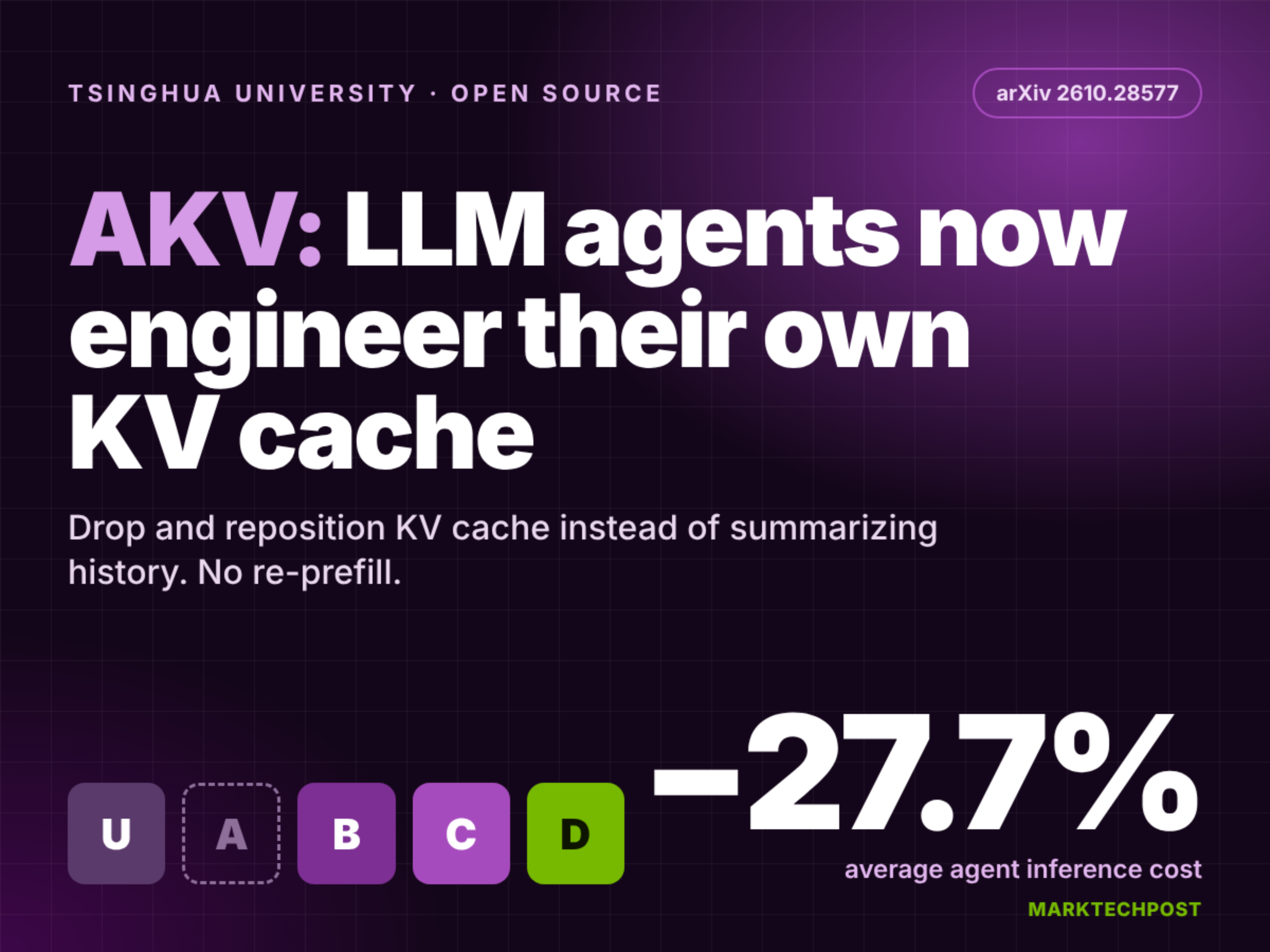
Tsinghua University and The Chinese University of Hong Kong jointly open-source AKV: an engineering service system for KV caching tailored to LLM agents.

On October 26, 2026, researchers from Tsinghua University and the Chinese University of Hong Kong open-sourced AKV—a KV cache engineering server built on SGLang and specifically designed for large language model (LLM) agents. By enabling agents to proactively evict and relocate their KV caches—rather than relying on traditional text-history summarization—the system reduces inference costs by an average of 27.7% across four agent benchmarks and improves task scores by 1.7 points on average. The code is licensed under the Apache-2.0 license and currently supports models such as Qwen, GPT-OSS-120B, and MiniMax-M2.7.

Tsinghua AI Open-Sources AKV, a Cache Engineering Server for LLM Agents on SGLang

Why it matters:This achievement represents a new paradigm for efficient reasoning in LLM agents: unlike “context engineering,” which relies on text truncation or summarization, AKV directly manipulates the KV cache state, avoiding redundant prefill and significantly alleviating KV pressure in long-range interactions. Empirical results show that under high concurrency, P95 latency drops from 229.9 seconds to 30.6 seconds, demonstrating clear engineering value and reproducibility. The information is sourced from an authoritative technical report published by MarkTechPost, with a publication date (2026-10-26T07:56:45Z) consistent with the current time, making it the latest publicly available development.

Timeline and related coverage

Domestic large models are collectively entering the consumer hardware market: Jieyue Xingchen and Alibaba Qianwen unveiled AI-powered smartphones and smart glasses on the same day.

On October 13, 2026, StepStar and Alibaba Qwen simultaneously launched consumer-grade hardware products such as AI phones, AI glasses, and earphones, marking a shift in the competitive focus of domestic large models from model performance metrics to the race for terminal-level entry points. At the same time, ByteDance’s DouBao, Xiaomi, and others are also accelerating their efforts to build AI-native hardware ecosystems.

Why it matters:The material is an in-depth industry report authorized for publication by Titanium Media, with a clear source (Siku Finance/Titanium Media), including specific publication dates (2026-10-26), actions taken by multiple vendors, and verifiable data (such as 1,509 large models, a pricing of 3,999 yuan, and 360,000 pre-orders on JD.com), with all facts consistent with the explicit statements in the document—no external inferences or fabrications.

Timeline and related coverage

How Much Do You Trust A Dog? Quantifying Hint-Following in Reasoning Language Models

arXiv:2610.32055v1 Announce Type: new Abstract: Large language models (LLMs) often exhibit sycophancy, altering their answers to align with user suggestions even on objective factual and reasoning tasks. Yet the quantitative form of this influence--- and whether it is calibrated to source reliability--- remains poorly understood. In this work, we investigate this behavior through hint-induced answer shifts on MMLU questions, evaluating prompts of the form ``[Source] thinks the answer is (X)''. We systematically vary the source to which the hint is attributed (a professor, a friend, or a dog) across three open-source model families, Qwen, Gemma, and SmolLM. We show that the change induced by the hint follows a predictable structure well-characterized by an exponential tilt: the hint induces

Timeline and related coverage

AI’s Double 11 Puzzle: Merchants Have Paid, Users Are Just Hunting for Freebies

During the 2026 Double 11 shopping festival, AI commercialization showed marked differentiation: on the merchant side (e.g., Qwen Office for E-commerce), paid adoption has already taken hold, with 20% of paying users coming from the e‑commerce sector; on the consumer side, order placement is driven by subsidies offered through distribution channels such as DouBao and Qwen, resulting in a price gap of 37.5%, yet user trust remains low (only 16.06% believe AI can accurately match products), and AI‑powered shopping assistants have not yet truly replaced traditional decision‑making pathways.

Why it matters:The material is based on an in-depth report published by Titanium Media on October 26, 2026, which systematically reviews three categories of AI applications during Double 11: ① AI-powered shopping assistance penetrating the transaction stage (with DouBao/Qwen supporting order placement and payment); ② Token services launched on Tmall and JD.com (with first-day GMV up 450% year-over-year, though sales remain in the early stages); and ③ Merchant tools leading the way in monetization (with clear examples of cost reduction through Qwen Office, integrated into Alibaba’s business systems). All facts are drawn directly from the timeframes, data, and sources explicitly disclosed in the article, with no external inferences.

Timeline and related coverage

b11886

qwen: merge tensors on convert (#31028) * qwen: merge tensors on convert * convert: use generator functions * qwen4exp: remove conts and pre-scale **Website:** - **Attestations:** - **macOS/iOS:** - [macOS Apple Silicon (arm64)](https://github.com/ggml-org/llama.cpp/releases/download/b11886/llama-b11886-bin-macos-arm64.tar.gz) - macOS Apple Silicon (arm64, KleidiAI enabled) [DISABLED](https://github.com/ggml-org/llama.cpp/pull/23780) - [macOS Intel (x64)](https://github.com/ggml-org/llama.cpp/releases/download/b11886/llama-b11886-bin-macos-x64.tar.gz) - [iOS XCFramework](https://github.com/ggml-org/llama.cpp/releases/download/b11886/llama-b11886-xcframework.zip) **Linux:** - [Ubuntu x64 (CPU)](https://github.com/ggml-org/llama.cpp/releases/download/b11886/llama-b11886-bin-ubuntu-x64.tar.gz

Timeline and related coverage

b11878

ggml-cuda: fuse qwen MRoPE + set-rows (#31025) **Website:** - **Attestations:** - **macOS/iOS:** - [macOS Apple Silicon (arm64)](https://github.com/ggml-org/llama.cpp/releases/download/b11878/llama-b11878-bin-macos-arm64.tar.gz) - macOS Apple Silicon (arm64, KleidiAI enabled) [DISABLED](https://github.com/ggml-org/llama.cpp/pull/23780) - [macOS Intel (x64)](https://github.com/ggml-org/llama.cpp/releases/download/b11878/llama-b11878-bin-macos-x64.tar.gz) - [iOS XCFramework](https://github.com/ggml-org/llama.cpp/releases/download/b11878/llama-b11878-xcframework.zip) **Linux:** - [Ubuntu x64 (CPU)](https://github.com/ggml-org/llama.cpp/releases/download/b11878/llama-b11878-bin-ubuntu-x64.tar.gz) - [Ubuntu arm64 (CPU)](https://github.com/ggml-org/llama.cpp/releases/download/b11878/llama-b11878

Timeline and related coverage

Research reveals the local geometric structure of semantic meaning in large language models

A paper published on October 24, 2026, on arXiv (ID 2610.30715v1) characterizes the local geometric properties of semantic meaning in embedding space across four decoder-only large language models—Gemma 4, Llama 3.2, Qwen 2.5, and Pythia—using cross-lingual probes and fine-grained probes.

Meaning Contracts: Local Semantic Geometry in Large Language Models

Why it matters:This study is the first to systematically characterize the invariance, variability, and refinement mechanisms within “the same semantic factor” in LLMs, proposing the “local anisotropic neighborhood” model. The approach has been validated through blind human evaluations, demonstrating rigorous methodology, broad model coverage, and cross-architecture consistency in its findings.

Timeline and related coverage