Skip to content
AI NEWS JOURNAL
AI, IN PERSPECTIVE

Search AI news

Search headlines, summaries and articles to connect the dots.

Newest first

b12175

A fix was implemented to override the hardware_concurrency value in CI tests, addressing an issue where test-llama-context and test-backend-ops hung due to incorrect thread count estimation on 8-CPU runners. The solution sets default values of 8 for TEST_ARG_HARDWARE_CONCURRENCY and 4 for TEST_ARG_PARALLEL_WORKERS specifically for the cpu-x64-high-perf configuration.

b12179

The update introduces support for 3D convolution (conv_3d) on Hexagon hardware by generalizing the existing conv_2d implementation. It leverages the HMX tiled path, folds kernel dimensions into a virtual row, and uses a shared solver with an is3d flag. The host computes unfold divisors to avoid device-side division, prevents DMA queue overflow, and improves tile size selection based on VTCM usage. Additional changes include handling arbitrary positive strides, preserving load/shuffle paths for small strides, and fixing compiler warnings.

Show HN: Combining Bursts of Images

An approach of taking many photos to enhance one final image is a technique called "stacking". Stacking alone doesn't account for everything so this is a take that helps get better alignment of images, allows comparisons, and drop bad images that dont match. Its not super resolution but it feels like when you look at it. it reduces the noise and makes it look more organic shot with less expensive hardware. enjoy! Comments URL: https://news.ycombinator.com/item?id=50401218 Points: 1 # Comments: 0

Zyphra ZYFA: FP8 FlashAttention for AMD MI355X, Up to 1.76x Faster

Zyphra released ZYFA, open-source FP8 and BF16 prefill attention kernels for AMD Instinct MI355X. On real model activations, its FP8 kernels run 1.16-1.76x faster than AMD’s AITER, with 62-78% lower error at head dimension 128. The post Zyphra ZYFA: FP8 FlashAttention for AMD MI355X, Up to 1.76x Faster appeared first on MarkTechPost.

Agents Are Going Async

Async subagents let an agent stay responsive while background workers run long tasks. How the orchestrator, notifications and approvals work in Deep Agents.

NUMA-Torch: Compiler-Driven NUMA-Aware LLM Prefill on Multi-Socket CPUs

arXiv:2611.07105v1 Announce Type: new Abstract: For sufficiently large transformer-based Large Language Models (LLMs), whose parameters cannot be retained in on-chip caches, prefill throughput on multi-socket CPUs is often limited by sustainable DRAM bandwidth rather than peak floating-point throughput. In the standard PyTorch compilation (i.e., TorchInductor) path, model weights are allocated without considering the Non-Uniform Memory Access (NUMA) topology: specifically, the affinity between memory banks and compute cores is disregarded. This causes a substantial fraction of weight accesses to traverse the inter-socket interconnect, severely degrading the effective memory bandwidth available to each socket. We address this bottleneck through a compiler-level solution that makes TorchInductor NUMA-aware. Treating each NUMA socket as an independent tensor-parallel partition, we introduce NUMA-aware Tensor Parallelism (NUMA-TP). This approach transparently shards weights across sockets and schedules compute kernels such that thread pools and memory allocations remain strictly local to their respective sockets using CPU affinity. We evaluate the approach on GPT-2 (117M, 345M, 762M) and BERT (Small, Large), which exercise standard multi-head attention and MLP, as well as Gemma 3 270M, which combines Multi-Query Attention with a GeGLU-gated MLP. By strictly enforcing data locality, our approach successfully mitigates cross-socket traffic, achieving prefill speedups of up to 2.63x on a dual-socket Haswell platform, up to 1.87x on a dual-socket Cascade Lake platform, and up to 2.27x on a four-socket Haswell-EX platform.

Show HN: Repairer – close the breach when a Linux flaw goes public

As we've seen with the Ubuntu critical CVE-2026-98432 (CVSS 9.8), AI-dicovered zero day exploit are being reported at an exponential rate and we don't have the process for dealing with the flood of exploits in real time.What we need is an AI-based system for autopatching systems based on real time information. The vendor's fix can take days or weeks to be out (is the Ubuntu thing patched yet?) and meanwhile the grid is vulnerable to exploitation, especially AI worms.Repairer is a small program that runs on each of your servers. The day an exploit goes public it puts up a stopgap that blocks it, and once the real fix is up it takes the stopgap back off by itself.A stopgap only takes something away — drop certain packets, turn off a kernel module or service, remove a setuid bit. It never opens a port, installs or downloads anything, nor runs code. It arms an undo playbook before applying the stopgap, so the change reverts if affects any services.It only ever acts on rules you sign with a (hardware) crypto wallet.Let's go further: stopgaps are written and checked by a swarm of AI agents (gnosh.ai sessions) running on gno.land, each with bonded stake. Each stopgap is run on fresh machines, and whoever is caught lying loses their stake to whoever caught them.The agent is built and tested on Ubuntu and Debian, all open source, standard-library Go. More distros coming. Let's build repairer together.https://gno.security/repairer/ https://github.com/gnosecurity/repairer Comments URL: https://news.ycombinator.com/item?id=50388417 Points: 1 # Comments: 1

Show HN: Resource Manager – Manage all resources on the computer

Hello everyone, I'm BIOcanse.Windows Task Manager has inaccurate readings and limited monitoring items. Various hardware adjustments are also very separated—CPU, GPU, and fans all require their own individual software. Their interfaces and interactions are primitive, and they often overwrite each other's configurations. Moreover, driver management of the CPU and GPU is too clumsy, and the memory usage issue on Windows is also very serious. So I made Resource Manager to view and manage all these resources in one place, making monitoring and scheduling work seamlessly together.Monitoring:This software integrates almost every possible monitoring item, letting you look at your computer from a God's-eye view!Scheduling:One of the core features. It uses algorithms I wrote to optimize memory usage and reasonably schedule processes across multiple CPU cores. It also supports GPU scheduling, which means it can switch the GPU a program uses while it is running. For example, after launching a game, if GPU usage is high or VRAM is about to overflow, it will move the remaining software to another GPU (for most personal computers, this is usually the integrated GPU).Reporting:Many times, computer performance problems are actually just caused by a single program or driver—the benefits of 100 programs optimizing themselves cannot make up for a memory leak in just one program. The reporting page reports abnormal resource usage (CPU, GPU, memory, VRAM, disk read/write, network traffic, and causing system interruptions).Hardware Adjustment:All the parameters you can think of for hardware like the CPU and GPU can be adjusted here. However, my own setup is an AMD CPU + NVIDIA GPU, so other setups still need to be verified. I do have several computers with Intel CPUs to verify Intel CPU support, but I really do not have a single AMD GPU. Although most of it uses mature open-source dependencies, there may still be risks, so please use it with caution. Comments URL: https://news.ycombinator.com/item?id=50380521 Points: 1 # Comments: 0

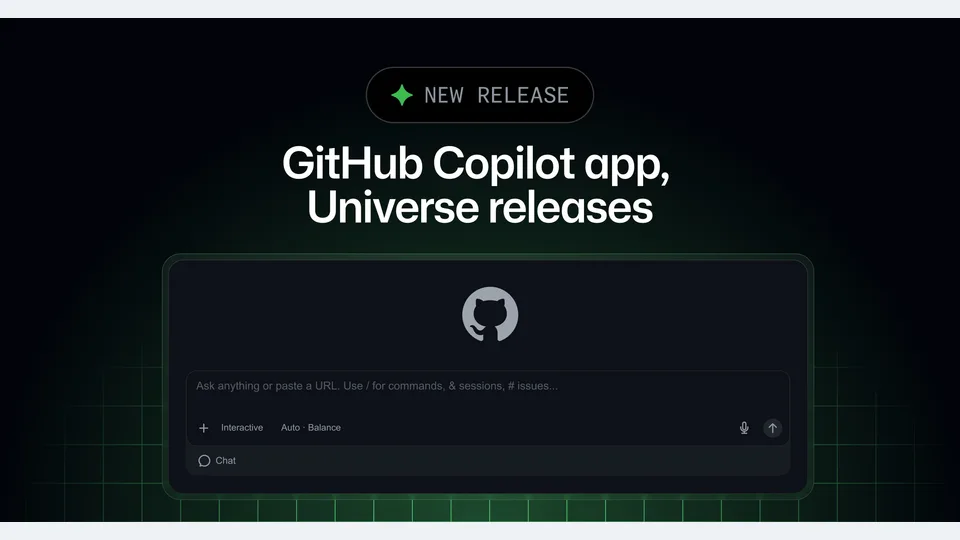
GitHub Copilot app, Universe releases

Work doesn’t always fit in a single repository or session. A feature can span several repositories. A launch plan can pull in specs, designs, and assets without touching a repository… The post GitHub Copilot app, Universe releases appeared first on The GitHub Blog.

新闻源配图 · GitHub Copilot changelog
Timeline and related coverage

INC-MoE: Overlapping In-Network Collectives and Expert Computation for Expert-Parallel Mixture-of-Experts Inference

arXiv:2610.36339v1 Announce Type: new Abstract: In expert-parallel mixture-of-experts (MoE) serving, dispatch moves tokens to the accelerators hosting their selected experts, and combine returns expert outputs to each token's owner. Both operations lie on the critical path and can dominate MoE layer latency in multi-node deployments. We present INC-MoE, an expert-parallel MoE layer that offloads dispatch and combine to the network switch and overlaps both collectives with each other and with expert computation. Dispatch uses in-network AllGather through switch-side multicast, while combine uses in-network ReduceScatter through switch-side reduction. Both collectives use message semantics between the end hosts and the switch. Because the in-network collectives load opposite directions of ea

Timeline and related coverage